EAST LANSING, MI. Dion Ginanto, an assistant professor at UIN Sulthan Thaha Saifuddin (STS) Jambi and an alumnus of Michigan State University’s K‑12 Educational Administration program, delivered a presentation on the implementation of Collaborative Online International Learning (COIL) during a Brown Bag session at the College of Education, Michigan State University (MSU), on September 30, 2026. The event took place in Room 133F Kiva and was attended by faculty members and students in both in‑person and online formats.
The session highlighted the expanding role of COIL as an alternative model for international learning. Dr. Ginanto explained that COIL provides access to global academic collaboration for students who face financial, administrative, or competitive barriers to studying abroad. Through COIL, students from Indonesia and the United States participate in joint classes, discussions, and cultural exchanges using platforms such as Zoom, WhatsApp, and email.
Dr. Ginanto noted that COIL classes conducted between UIN STS Jambi and MSU, as well as with the University of Wyoming, have enabled students to interact directly with foreign professors and engage in cross‑cultural academic dialogue. He emphasized that COIL requires minimal cost, relying primarily on internet access, which has become a basic necessity for students. “With only a data package, students can enter an international classroom,” he said.
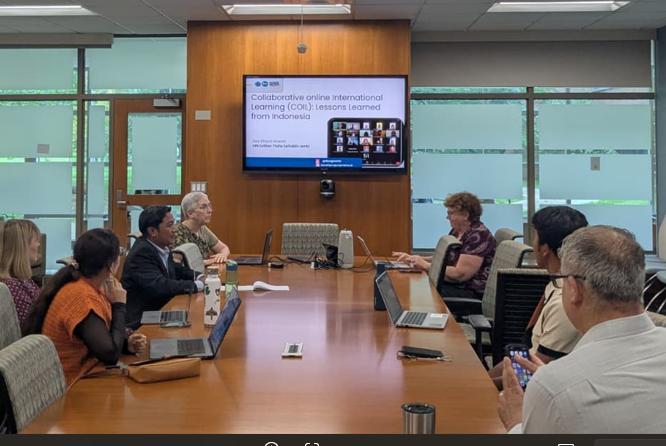
Participants actively engaged in the discussion, raising questions about technical implementation, student readiness, and opportunities for future collaboration. Julie Sinclair, Associate Director of the Office of International Studies in Education at MSU, stated that COIL has gained significant traction in American higher education. “COIL has become highly relevant in the United States. MSU even provides small funding for faculty members interested in developing COIL courses,” she said.
Sinclair added that hearing about COIL from the Indonesian perspective offered valuable insight into how the model can be adapted across different educational contexts.
At the conclusion of the session, Ginanto expressed hope that UIN STS Jambi would continue strengthening its COIL programs and eventually become a national reference point for universities seeking to implement similar initiatives. “COIL is the future of education, not only for knowledge exchange but also for cultural and linguistic understanding,” he said.
The event underscored the growing importance of virtual international collaboration in higher education and highlighted UIN STS Jambi’s commitment to expanding global learning opportunities for its students and faculty.